Origins of the Society
It all began on the evening of Friday, 6th December 1963, when seven disgruntled beer drinkers gathered at their local, the Rising Sun in Epsom. By the early 1960s, a combination of factors had led to the spread of keg beers, often at the expense of traditional draught beers. These factors included indifferently kept beers in many pubs, the brewers’ desire to attract more custom, wider distribution as brewery companies expanded through take-overs, and the growth of commercial television.
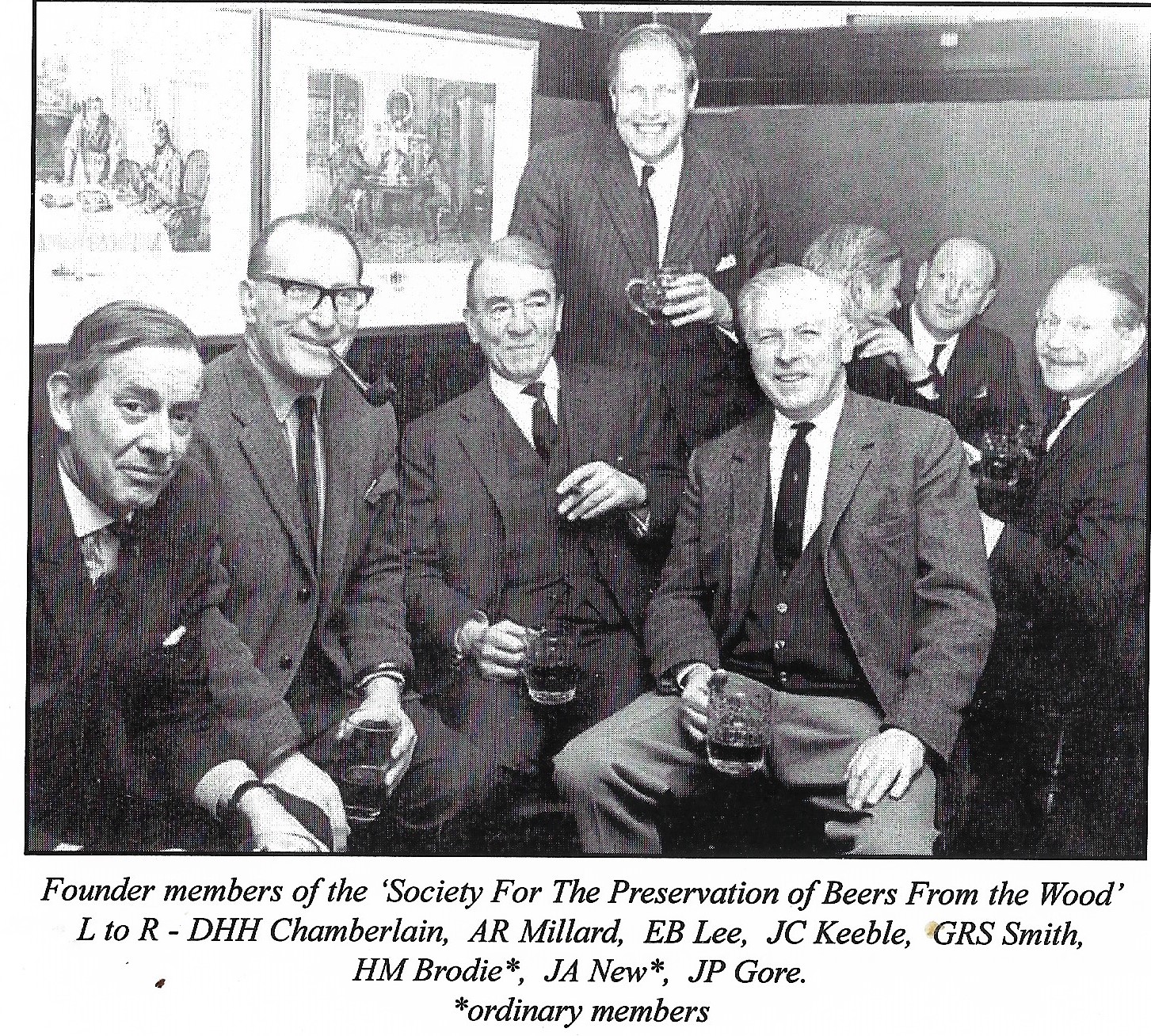
The seven – Arthur Millard, Dougie Chamberlain, John Gore, John Keeble, Boyes Lee, Gerry Smith and Penri Thomas, most of whom worked at the Bank of England – were dedicated beer drinkers, and they were deeply concerned. They saw a growing decline in both the quality and palatability of beer, which they put down to the increasing use of gas pressure dispense and the introduction of keg beers.
They deplored the monolithic policies of the big brewers which, accepted with a spineless lack of gumption by many publicans, were forcing the sale of beer from ‘sealed dustbins’. This threatened the availability of traditional draught beer and denied discerning drinkers their tipple of centuries: beer drawn from the wood.
The seven decided to form a society to draw attention to their plight, and so the SPBW was born. It may have been founded in a mood of mixed bonhomie and militancy, but it provided the first voice to speak up for the consumer and question the actions of the big brewers.
Beer from the wood?
In 1963, wooden casks were still regarded as synonymous with traditional draught beer, in contrast to the sealed dustbins containing the processed and artificially carbonated product. The name, the Society for the Preservation of Beer from the Wood, therefore seemed ideal. At that time all ‘real’ beers were served from wooden casks, as opposed to the metal casks used for keg beers. Since beers drawn from the wood were then still widely available, the founders felt they should be set up as the most desirable form of beer to be preserved.
As time went by, wooden casks became scarcer and brewers took to using metal casks for traditional ales. It was then plain that the SPBW’s aims were more simply defined as opposition to gassy, processed beers. In 1968 it was decided that the Society’s main concern is the beer in the cask, and that it should be served as a quality product. So the standing orders were revised to permit the drinking of all but ‘dustbin’ beers.
This decree was greeted with outrage by one of the SPBW’s more fundamentalist branches, in Wiltshire, which held that the only beer worth drinking was drawn directly from the wooden cask by gravity. The Founder Members replied that, if such strictures were applied, many less fortunate members elsewhere in the country would be obliged to go dry.
By the 1970s metal casks had become prevalent, yet the original name was retained for the sake of tradition, even though it is rather misleading, since the Society has mostly been more concerned with the contents than the container.
Early years
What had started in a somewhat light-hearted manner soon became more serious. The SPBW may have started with a few beers and bold words, but it was clearly involved in a cause dear to British hearts. By the end of the 1960s it had built up into a fairly large, loosely associated national body, with 30–40 branches and several thousand individual members.
Campaigning was fairly low-key during this time, but a useful amount of media and press publicity was gained, some of it from ‘mock funerals’ held at pubs that had been blighted by keg or ‘dustbin’ beers.
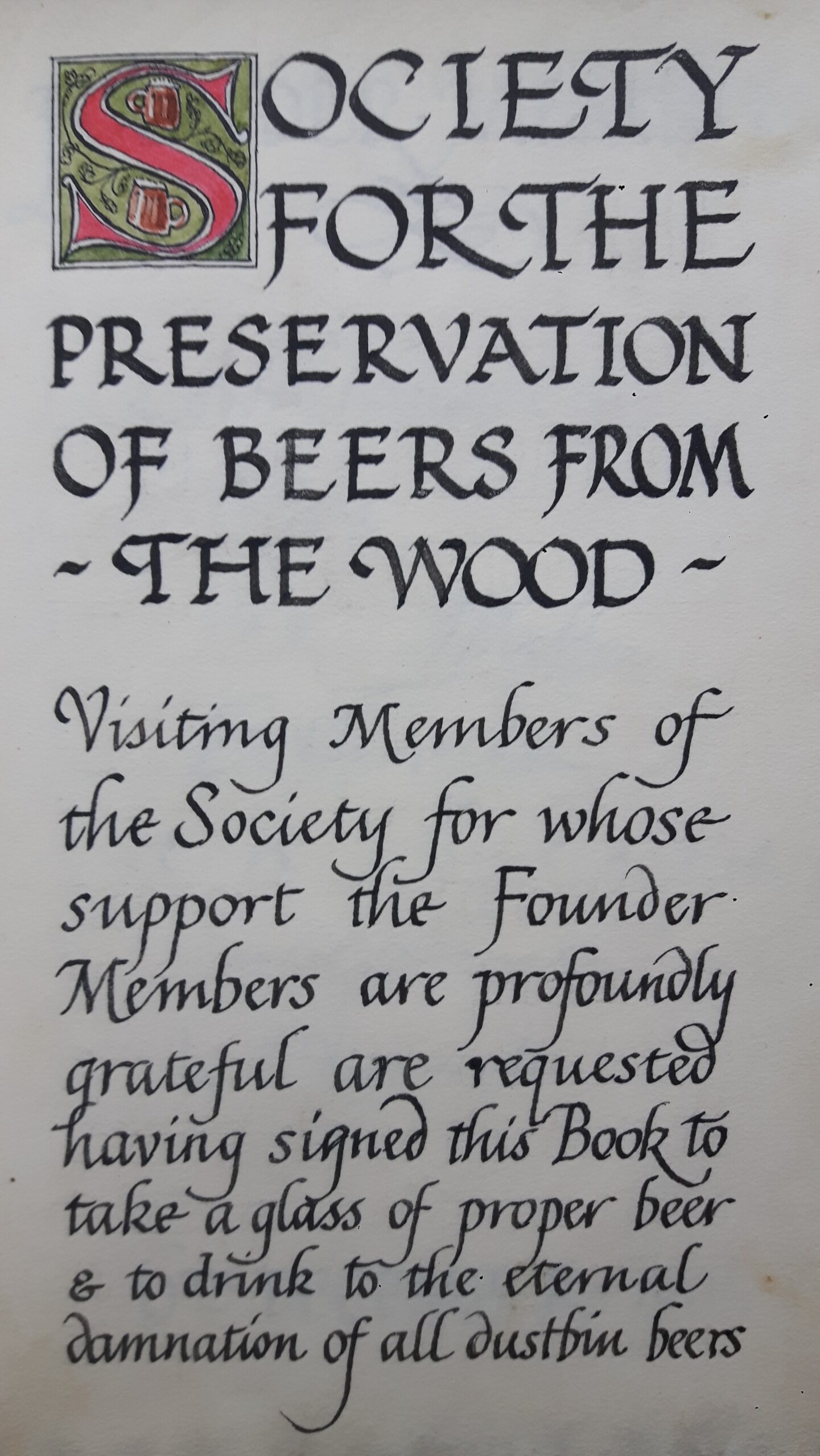
‘Festival of Fraud’
In October 1972 the SPBW organised, with the then emerging CAMRA, a protest against its exclusion from a so-called National Beer Festival, a trade-run, keg-dominated event at Alexandra Palace, following representations from some of the major breweries involved. The event was denounced as the ‘Festival of Fraud’ and proved to be something of an ‘own goal’ for the breweries, given the amount of favourable publicity it gave the SPBW.
From this time, however, the Society’s public profile went into something of a recession. Keg beers had become more widespread, and CAMRA, with its more centralised and aggressive tactics, began to take the forefront in the battle for good beer.
Consolidation and growth
Away from the headlines, the Society was putting its house in order. A National Executive Committee (NEC) was formed in 1973, with Frank Manning as its first Chairman, and in 1978 the SPBW ran a stand at the Great British Beer Festival for the first time. It would appear there regularly until 2003, the last occasion to date.
The branch network had been growing since the first branch was established in the Ulverston area in 1964. Campden Hill, now the oldest surviving branch, was founded in 1965 at the Windsor Castle, Kensington, and Wantz followed in 1974 at the Cauliflower, Rainham, in Essex.
The 1980s saw the Society’s social calendar take shape. Pint in Hand first appeared in February 1982 and has been published quarterly ever since. The first National Weekend, held in Devizes over the late May bank holiday that year, started a tradition that continues today. Inter-branch rivalry found an outlet in the Tony Littler Trophy, first contested in September 1985, and the London Pub of the Year competition, launched in 1980, lapsed for 14 years before being revived in 2002.
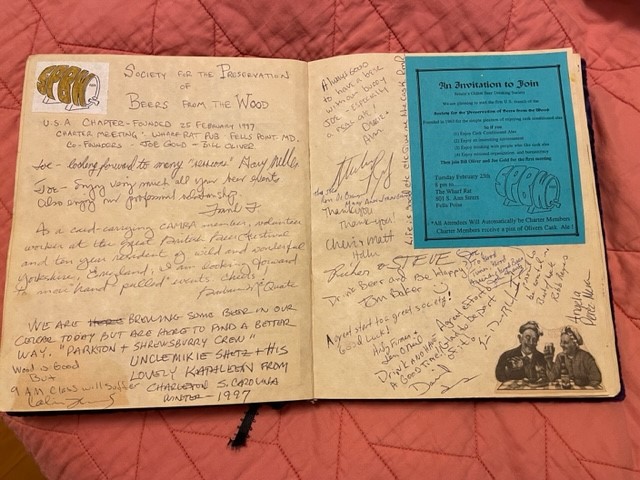
Milestones were marked in style, with anniversary dinners in 1984, 1988, 2003 and 2013, the first attended by Founder Members John Gore and John Keeble. The last surviving Founder Member, John Keeble, died in July 2023. In the 1990s and after, the Society looked outward. Its website was launched in 1996, and it acquired its first overseas branches, among them Chesapeake Bay, in Baltimore, in 2000, and Casktores, in Luján, Argentina, in 2021.
The SPBW today
Nowadays the SPBW has several hundred members throughout Great Britain and abroad, and over twenty active branches, the largest and liveliest being in Greater Manchester, the West Riding of Yorkshire and Tyneside. The NEC maintains contact with breweries and other relevant bodies on issues of concern. The Society recognises naturally conditioned beer but rejects gas pressure dispense, so its aims are similar to those of CAMRA. Because of the entirely voluntary set-up, however, the emphasis is on activity within its autonomous branches.
The SPBW has largely evolved into a social body, with most activities arranged by the branches; visits to breweries are particularly popular. The annual National Weekend brings members together in areas of special beery interest, with traditional breweries to visit and fine pubs and beers to sample. Recent venues have included Newcastle, Bristol and London, and earlier ones Norwich, North Wales and the Isle of Man. Even so, the Society does its bit for the cause of good beer by promoting excellence in beers and pubs.
Aims of the Society
The aims of the Society are as follows:
(a) To stimulate the brewing and encourage the drinking of traditional draught beer, drawn direct from the cask by gravity, electric pump and traditional handpump, or by other methods approved by the National Executive Committee (this includes bottle-conditioned beer).
(b) To lend support to those brewers who, by their policy, assist in the implementation of the Society’s aims.
(c) To discourage the brewing and sale of beer termed ‘draught’ but served otherwise than described above, and to discourage its consumption.
(d) To support and encourage breweries and pubs that use wooden casks, and the coopers who produce them, although the Society does not specifically campaign for the use of wooden casks for beer dispense.
The wood revival
At the start of the 21st century, only a very few breweries were producing beers served from wooden casks, and there were only one or two active coopers in the UK. Since then there has been a notable revival in the use of wood for maturing and dispensing beer. This has been further stimulated by the determination of SPBW activists, mostly in the north east and Yorkshire, to promote the merits of beers from the wood. Historically, wooden casks were lined to prevent contact between wood and beer, but brewers have come to appreciate that the flavour and character of beer can be enhanced by the wood. The SPBW supports this trend and the traditional craft of the cooper, and now looks to encourage the use of wooden casks.
In recent years the Society has seen a significant upsurge of interest from many newer breweries, and from a few well-established brewers wishing to revive the use of wooden casks. The SPBW’s Beer from the Wood breweries page lists nearly 50 breweries; some mature their beers in wood before bottling, while many others supply beer in wooden casks. The Society is developing closer ties with these brewers, and with CAMRA branches and local pubs and clubs running beer festivals, to make beers served in wooden casks more widely available.
Woodfest
To showcase the growth of beers from the wood, the SPBW organised its first ‘Woodfest’ in 2017 in Castleford, Yorkshire, next to the Junction, a pub serving exclusively beers from the wood. May 2026 saw Woodfest 6, featuring 50 beers served from wooden casks and attracting considerable interest. Before the start of each Woodfest, a tasting panel chooses the ‘Woodfest Beer of Britain’ (WBOB), and an award is given to the winning brewery. The last two WBOBs have been won by Tigertops Brewery of Wakefield for its Edwardian Porter.
Key dates
See the Key Dates page.
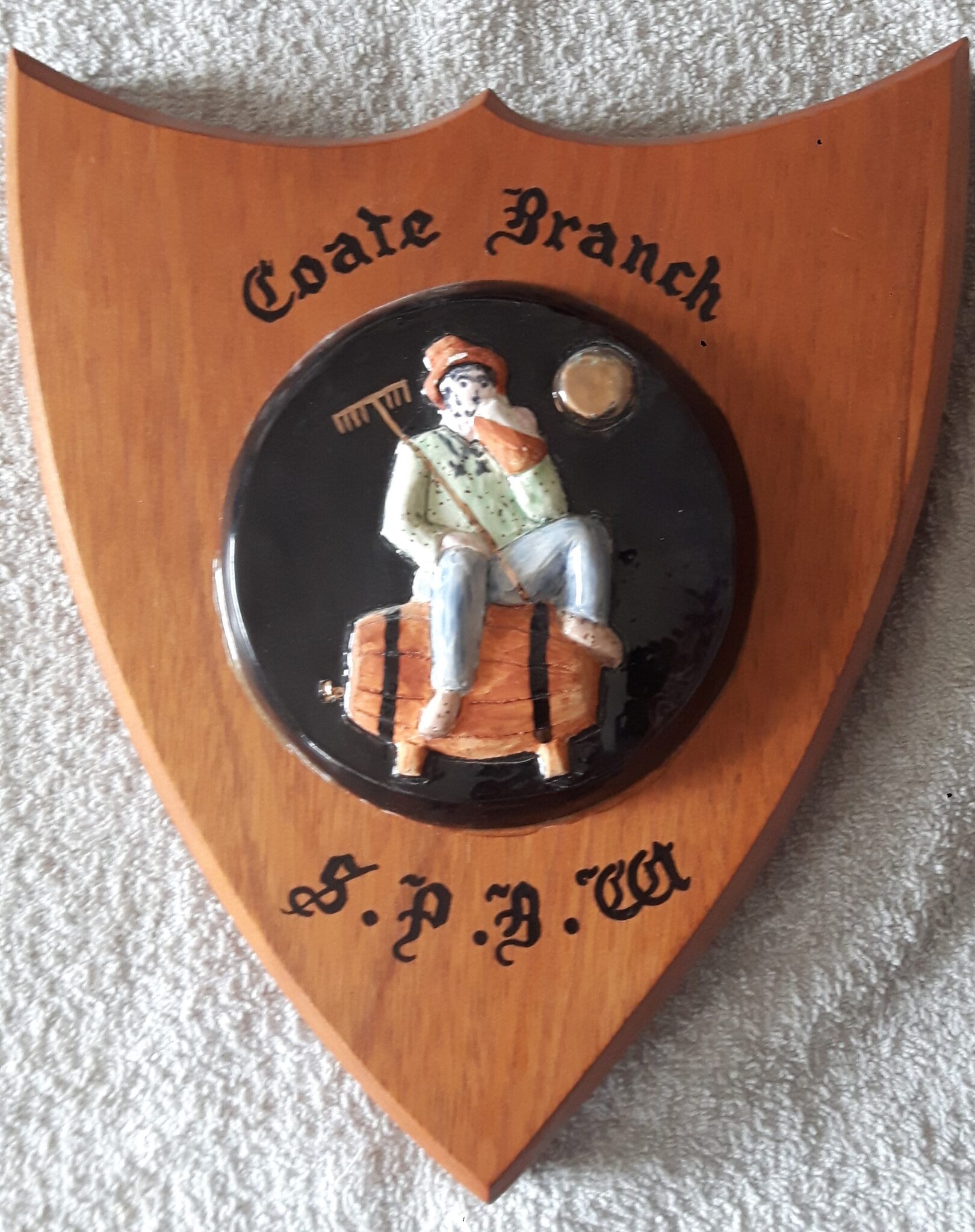
St George’s branch, City of London
